Oban Airburst Burgundy Golf Shaft Review

Oban Airburst Burgundy Driver Shaft Review

By Russ Ryden, Fit2Score, A Dallas Fort Worth Club Fitter & Club Maker
The Highlands Performance Golf Center, Carrollton Texas 
Golf Digest Certified America’s 100 Best Club Fitter

The Airburst Burgundy is the second shaft made by Olympic for Oban. Olympic is a premium Japanese fishing rod company. They specialize is fishing rods which are much like golf shafts, hollow carbon fiber tubes. The Olympic website has an in-depth discussion of carbon fiber properties of tubes. If you have never seen the manufacturing of a graphite golf shaft I recommend you watch this video about fishing rod construction. From 0:56 to 5:30 you are watching the process of the making of a graphite golf shaft. Graphite shafts are with few exceptions hand rolled. No one in the golf shaft business will publish a video about the manufacturing process they use. This is how it is done:

Ralph Reichert, owner of Oban Golf shafts discusses the making and technology of the Airburst golf shafts in this video from my my YouTube Channel, Devoted Golfer, We shot this discussion at the January 2019 PGA show.

Lets take a look at the second Airburst golf shaft from Oban.

To continue reading this section of the review, you must be registered at a higher level membership.
Russ

Fujikura MCI Iron Golf Shaft Review

Fujikura MCI Metal Composite Iron Golf Shaft

By Russ Ryden, A Golf Digest America’s 100 Best Clubfitter
Fit2Score, Dallas Fort Worth, Texas

FujiMCIImage

We are in a new era in iron shafts. Composite shafts have found their way to the PGA Tour. Acceptance of ‘graphite’ shafts by tour pros means serious amateurs will consider playing them. The shaft companies are responding with tour quality composite shafts. The MCI shaft from Fujikura is truly a composite, it is made from graphite with a metal fiber wrapped into the tip section.

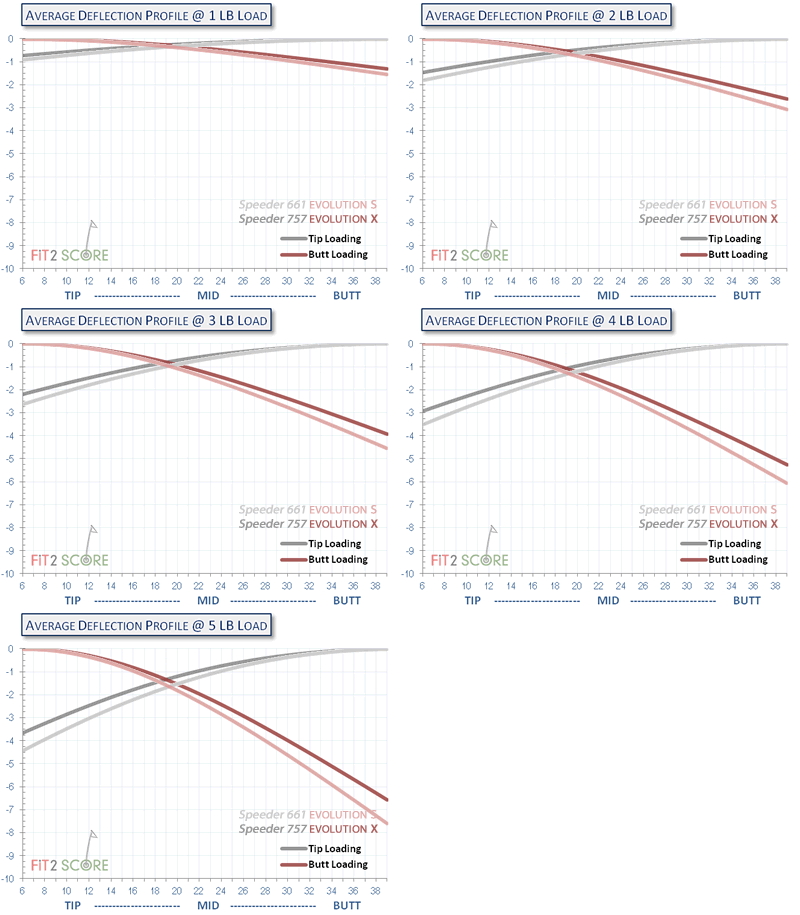
The bend profile is seen in many of the current generation of performance orientated iron shafts. It resembles the design seen in driver shafts. Much higher tip to butt rations than we typically see in iron shafts. That is going to create a propensity for higher launch. I confirmed that on a range. A cavity back iron fitted with the MCI launched the same as a game enhancement high launch design head fitted with a traditional bend profile design composite shaft. The feel was much the same. And for those looking for shock absorption, thin ball strikes are muted, the vibration is not transmitted to the hands. If your iron game would be improved by a little extra launch, you should be testing the Fujikura MCI shaft. The tip is similar to a Dynamic Gold S300. A stiffer butt creates a higher tip to butt ratio and a higher launch propensity.

Fuji_MCI_EiGjTb

Radial consistency of the MCI is very good.  The average of our review samples was 99.1% with a 0.6 Standard Deviations. Spine alignment is not necessary with these shafts. Fujikura marks every shaft with one of the flat line oscillation planes and puts the label on that plane. Installing the shafts label down is the equivalent of FLO alignment.

A view of factory cut iron shafts is not complete without looking a the makeup of the complete set. This is the first of many iron shaft reviews that will be updated with this important view of set profiles.

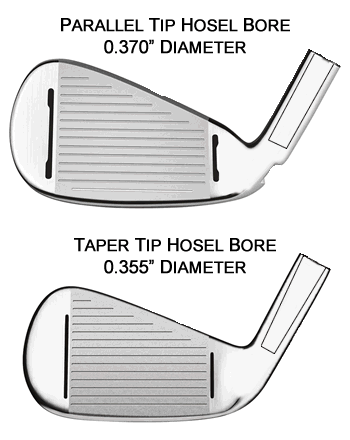
I avoid using the word constant weight tapers because not all cut to length iron sets are constant weigh nor are they tapers. The Fujikura MCI is constant weight, averaging 102 grams uncut, but it is .370 parallel tipped. The set illustrated below is the 100S. The EI profiles ascend consistently from shaft to shaft in the set.

Fuji_MCI_SetEI
To understand this aspect of shaft sets, look at the set profiles of the UST Recoil. By comparing these to set profiles you see why I referred to the UST Recoil as a flighted set. By contrast, the Fujikura MCI is similar to most constant weight steel shaft set profiles.


Oban Revenge Driver Golf Shaft Review

Oban Revenge Driver Shaft

Kirk James & Mark Vallier, Golf Digest America’s 100 Best Clubfitter
MK Golf Technologies,San Antonio, Texas

Measurements: Russ Ryden, Golf Digest America’s 100 Best Clubfitter
Fit2Score, Dallas Fort Worth, Texas

Revenge Driver Image

In our testing and fitting of the Revenge, the results have been consistent with the EI Bend Profile shown above and Oban’s description of the shaft in their marketing materials. The tip section of this shaft, described as “responsive” by Oban, is definitely softer than the the tip sections of the other shafts in Oban’s line. This “responsive tip” results in a mid-high to mid launching shaft with the launch progressively getting lower as the shaft gets stiffer. The use of ultra premium, high modulus graphite materials provides the typical Oban signature stability and feel. This shaft is both responsive and stable at the same time.

The technical discussion and measurements are available only to registered readers

Oban Revenge Hybrid Golf Shaft Review

Oban Revenge Hybrid Golf Shaft

Kirk James & Mark Vallier, Golf Digest America’s 100 Best Clubfitter
MK Golf Technologies,San Antonio, Texas

Measurements: Russ Ryden, Golf Digest America’s 100 Best Clubfitter
Fit2Score, Dallas Fort Worth, Texas

Revenge Hybrid ImageThese Revenge hybrid shafts do produce impressive dispersion results in real world testing, especially for shafts in these weight categories. The flight is mid-high to high, but they do not balloon, even in the Texas wind. The use of ultra premium graphite materials ensures a consistent bend profile, better performance and consistent shots. The low torque provides very tight dispersion. The moderately softer tip and butt sections of this shaft provide a responsive feel that never seems boardy.

The technical discussion and measurements are available only to registered readers

These hybrid shafts are highly recommended for the player with a smooth tempo. I personally play the Revenge 65\04 in two hybrids, and I can honestly say I have never played a more consistent, better feeling, or better performing hybrid shaft. I am constantly amazed at how tight the dispersion is and how flat the trajectory is with a 67 gram hybrid shaft. Consider looking at the Revenge 85 if you are a stronger, slightly more aggressive swinger. This is a very impressive shaft from Oban, and definitely worth your consideration if looking for a hybrid shaft.

Oban_Revenge_Hb_EITBTb

The radial integrity of the review samples was 98.6% with a 0.5% standard deviation. Hoop strength is high indicating very little ovaling is going to occur. Tip/Butt ratios were consistent throughout the range of weights and stiffness.They indicate a mid high launch propensity, decreasing with both weight and stiffness. You must remember, your personal experience will be how your speed and swing characteristics are matched to the weight and stiffness of these shafts. The tip torque numbers are impressive. Certainly not the lowest we have ever seen, but very respectable for shafts in this weight range. In our fitting experience, low tip torque hybrid shafts create tight dispersion groups.

/

To continue reading this section of the review, you must be registered at a higher level membership.
Russ

Diamama Red Golf Shaft Review

Mitsubishi Diamana R – Third Generation

By Russ Ryden, A Golf Digest America’s 100 Best Clubfitter
Fit2Score, Dallas Fort Worth, Texas

Diamana3Gen_R_Image

The last of the third Generation Mitsubshi Diamana driver shafts released in September 2014. The Diamana ilima, the second generation Diamana Red Board has long been my favorite fairway shafts. The expression, ‘if its not broken don’t fix it, applies the the third generation Diamana R. It changes very little over the second generation design. The butt stiffness is a little softer, allowing for a little more load at the start of the downswing. New material, high modulus 80 ton fiber is use in the hoop wraps in the shaft. In the butt, the hoop strength increases while the stiffness decreases. We are seeing more creative designs in carbon fiber golf shafts. Design is limited by the creativity of the shaft engineer and by the willingness of the golfing public to embrace these new products at ever increasing costs. At $400, the Diamana R, one of the greatest fairway shafts I know of, is beyond the typical $300 price of the off the rack fairway. You get what you pay for, and in this case, in the 70 and 80 gram models, you are paying for tip torque low enough to control the weight of a 3 wood head.

This is a high launch shaft. For those who hit their woods off the turf, where a downward angle of attack is all that is possible, a high launch shaft is a good thing. With a driver, and an upward angle of attack we would seek a lower launching design. But with a fairway, this is my design of choice.

MRC_DiamanaR_TbGr3gMDI

I checked 10 shafts, one of each weight and flex, the average radial consistency was 99.6% with a standard deviation of 0.2%. That is an example of the made in Japan tradition of excellence we have historically seen from Mitsubishi Rayon. This is the first shaft I know of to use 80 ton material. It is too stiff to be used in the linear and bias plies. It is used to create hoop strength. Because it is thin and has no open space like multi axis weaves it creates high hoop strength while leaving the shaft designer the space inside the multi layered wall to achieve the linear and torsional strengths he is seeking to achieve. All while creating a smooth lose of stiffness down the shaft and the unique Mitsubishi feel.

New to third generation Diamana R series are 50 gram shafts. The line between the ultra light driver shafts and light weight versions of standard shafts is getting blurry. The Diamana R series extends the profiles consistently into the 50 gram versions. Those with slower drive swing speeds that need launch and spin can get it without having to accept a high torque tip.

Now that the third generation Diamana release is complete, lets compare the three designs by looking at the 60 gram version of each shaft.

Diamana3Gen_60_RWBThese shafts are not as different as they once were. At least in the 60 gram versions. The Diamana B series was reviewed earlier as was the Diamana W. The profile of the Diamana W changes significantly in the 70 and 80 gram versions. But as you can see here, in the 60 gram version is it just a little higher launching than the Diamana W. The Diamana R is a different shaft. Softer handle, quicker loss of stiffness from mid to tip. All three shafts get stiffer as they approach the tip. If I want a stiffer shaft, I will always simply change to the next step on the stiffness progression, either getting the heavier of the stiffer model before I would consider tipping these shafts.

Graphite Design Tour AD SuperLite Driver Shaft Review

Graphite Design Tour AD SLII Driver Shaft

By Russ Ryden, A Golf Digest America’s 100 Best Clubfitter
Fit2Score, Dallas Fort Worth, Texas

GD_TourAD_SLII_ImageGraphite Design added a light weight shaft to the popular Tour AD Line in 2014. This shaft, like many others in the light weight category, ranges from 50g to 60g, with stiffness corresponding to weight. In this weight range, we see higher torques, but not so high that I would be concerned about head stability. These shafts are designed for swing speeds in the 60 to 85 mile per hour range. The 60g SR flex extends to the 90 mph range. My swing speed in in the high 90’s with the occasional 102 showing up and I am playing an ultra premium 59g shaft. Light weight driver shafts, made out of high quality carbon fiber are the future of golf for many of us. That couple of grams I lost in my latest shaft change has given me a new range of control and feeling without any increase in dispersion. In fact, I am hitting more fairways than I ever have now that I changed to a sub 60g shaft.
GD_TourAD_SLII_EiTBGjFsHpTbRadial integrity of the Graphite Design Tour AD SLII is exceptional, the review samples averaged 98.5% with a 0.4% standard deviation. The hoop strength is high for this weight range, and distinctly different in the 4 vs 5 models. This measurement is new for my knowledge base.

This is a unique design, there is no close match in the database. The tip to butt ratio and the tip load and butt load deflection analysis shows it to be a high launch high spin design consistent with what Graphite Design is saying about the shaft. In the speed range it is designed for, that is what will optimize distance. Tip torque is tight. Butt torque is in the range that transmits adequate feel in light weight shafts. If your swing speed is below 90 mph and you are looking for a quality shaft this is one you should be testing.